Money Basics | Investing
How to build an emergency fund with a time deposit

An emergency fund only works if your money is somewhere it can grow without being out of reach, and a time deposit may be exactly that place.
Whether you are just starting to build your emergency fund or rebuilding it, treating your cash reserve as a priority is a sound first step. It is generally advised to keep 6 to 12 months' worth of expenses in reserve; those with dependents may need 12 months to two years.
Having that money sit idle in a savings or checking account in the meantime is not ideal. Time deposits offer a way to put that money to work while you are building toward your target.
Where to put your emergency fund in the Philippines
When deciding where to put your emergency fund, the ideal vehicle keeps your money accessible, protected, and quietly earning, which is exactly what a time deposit is designed to do.
Time deposits let you park your cash for a period called your term. At the end of the term, you get your money back with interest. The interest you earn on your time deposit depends on two things: the amount of money you put in, called your principal, and the length of the term. The larger the amount and the longer the term, the higher the interest.
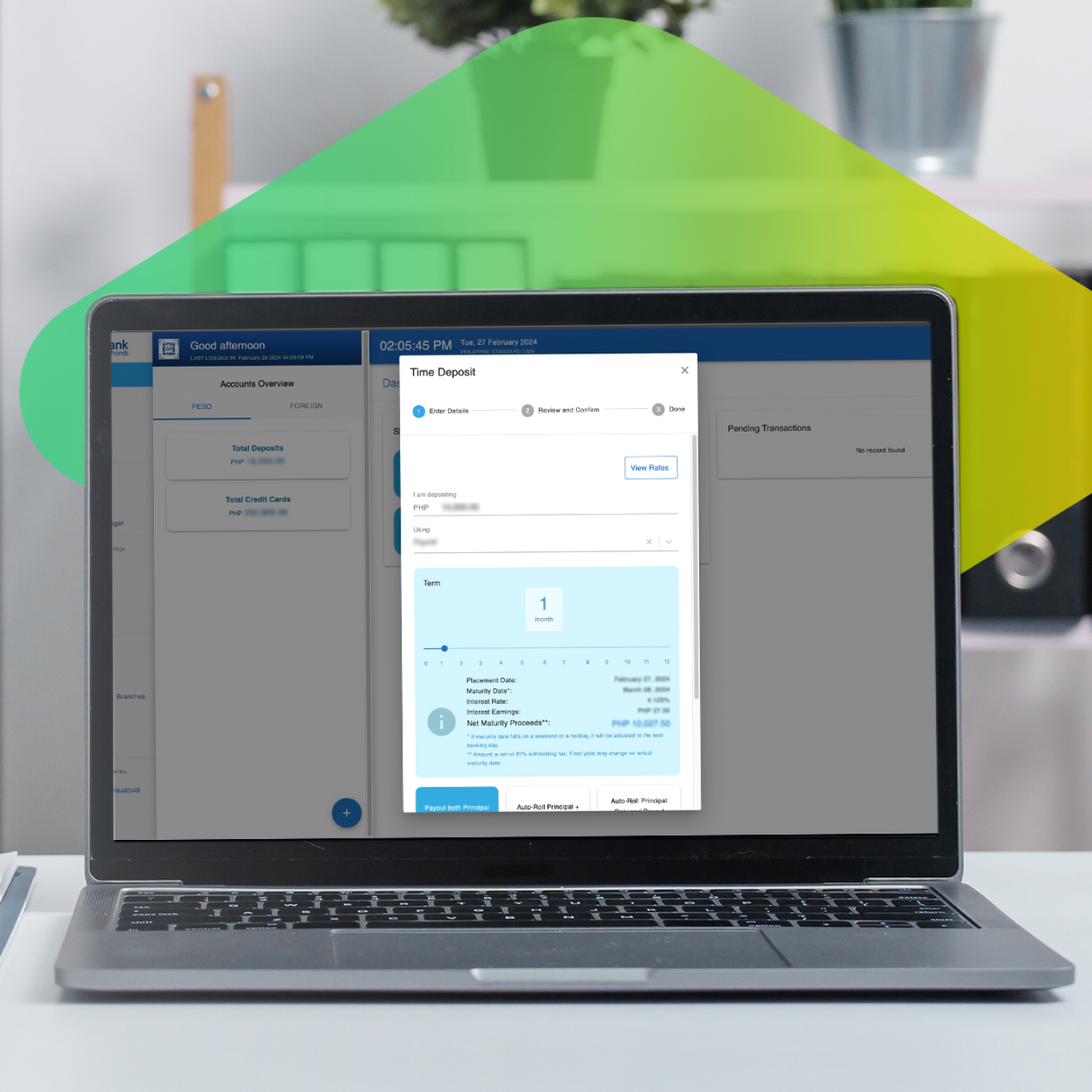
Reviewing the time deposit interest rate before opening an account helps you understand how much your money will earn across different terms and principal amounts. You can open a time deposit through Metrobank Online and choose a term that fits your timeline.
Time deposits and your emergency fund
Understanding how to build an emergency fund means choosing the right vehicle for each stage of the process, and knowing where to keep your emergency fund in the Philippines is a big part of that decision.
Time deposits are relatively straightforward and carry relatively low risk. It is worth noting that the potential for growth is modest, but unlike stocks, time deposits do not fluctuate in value—you do not have to worry about withdrawing your money at a loss.
Unlike bonds, time deposits have relatively short terms and low minimum investments. You can open a time deposit with a minimum of PHP 10,000 for a term as short as one month.
Keeping funds in a time deposit can also discourage unnecessary spending because you cannot withdraw them from an ATM. This can be helpful when rebuilding your emergency fund. You can pre-terminate before the end of the term, but you will receive only a fraction of the earned interest and will need to pay documentary stamp tax. Pre-termination is also subject to a 20% withholding tax for peso time deposits. Processing may take a day or longer if the pre-termination falls on a weekend.
It may not be ideal to keep your entire emergency fund in a time deposit for this reason. Once your emergency fund is fully in place, consider keeping it in a savings account for instant access, and use time deposits for any surplus savings beyond that.
Time deposit protection
Time deposits carry some risk, primarily if the bank holding your funds faces financial difficulty. The likelihood of this is low, given the strict regulatory requirements banks must meet. All deposits, including time deposits, are covered by the Philippine Deposit Insurance Corporation (PDIC) for up to PHP 1,000,000 per depositor per bank.
A strategy to rebuild your emergency fund
Having a clear plan for how to build an emergency fund makes the process more manageable, especially when cash flow is tight. Here is one time-deposit strategy to consider:
- Earmark everything you need for your essentials, bills, premiums, and debts for the month.
- If you have enough left to survive another month, keep it in savings. If not, save up and return to Step 1.
- When you can survive an extra month, put the remainder in a one-month time deposit.
- When it matures, repeat Steps 1 and 2, then set aside what remains.
- Open a new one-month time deposit, adding more based on what you can set aside.
Note that this is just one possible strategy designed to maximize flexibility. It is not designed with growth in mind. As with any personal finance approach, how you adapt it depends on your circumstances. If you have supplementary income from a side hustle, directing those earnings into a time deposit may help speed things up. If you have dependents, a one-month buffer might not be enough.
Once your emergency fund is fully in place, you may also want to explore passive income ideas to help your remaining savings continue growing over time.
DISCLAIMER: This article is for general informational purposes only and does not constitute formal financial advice. Always conduct further research before making financial decisions and seek professional advice from a certified personal finance counselor.
How to get started
Open a Metrobank time deposit online and start putting your idle savings to work at a fixed interest rate.
Frequently asked questions
How much should I keep in my emergency fund?
Where should I put my emergency fund?
Should I keep my entire emergency fund in a time deposit?
More Smart Reads