
Sustanability Report 2025
Environmental
We manage our environmental footprint responsibly, monitoring energy use, greenhouse gas emissions, and water stewardship, while directing financing toward projects that build climate resilience and strengthen resource security.
Energy Management
We manage energy with efficiency and discipline across our offices, centers, and branches. LED lighting, inverter-type air-conditioning units, timer-switches, and motion sensors reduce electricity demand, reinforced by periodic energy audits and a 52-week preventive maintenance program. In 2025, targeted measures delivered estimated efficiency savings of 5 to 10%.
| Energy consumption (MWh) | 2023 | 2024 | 2025 |
|---|---|---|---|
| Centers | 13,063.5 | 14,480.4 | 13,940.3 |
| Branches | 26,918.5 | 27,899.9 | 26,572.2 |
| Other assets | 3,822.3 | 570.4 | 712.2 |
| Fuel consumption (L) | 2023 | 2024 | 2025 |
| Centers | 73,395 | 80,780 | 70,409 |
| Branches | 63,008 | 67,345 | 50,825 |
Transitioning to Renewable Energy
Starting in 2026, we will begin implementing renewable energy solutions at approved pilot locations, including participation in the Retail Competition and Open Access (RCOA) and Green Energy Option Program (GEOP), as well as rooftop solar installations at strategic facilities.
| Pilot locations approved | Annual electricity consumption | Operational Emissions |
|---|---|---|
| 30 | ~11 GWh | ~8,000 tCO2e |
| Branches and Corporate Centers | across pilot sites | across pilot sites |
We also offer financing and payment options for residential rooftop solar installations, helping customers adopt cleaner energy and aligning our product suite with broader transition objectives.
Greenhouse Gas Emissions
We measure greenhouse gas emissions using the GHG Protocol operational control approach, covering Scope 1 direct emissions and Scope 2 location-based emissions from electricity use across our network. Improving emissions intensity across both workforce and revenue metrics shows we are operating more efficiently as our business grows.
| GHG Emissions (in tCO2e) | 2023 | 2024 | 2025 |
|---|---|---|---|
| Gross direct (Scope 1) | 345 | 375 | 307 |
| Gross location-based energy indirect (Scope 2) | 31,454 | 30,852 | 30,569 |
| Intensity ratio, tCO2e per full time employee (FTE) | 2.14 | 1.95 | 1.95 |
| Intensity ratio, tCO2e per Php million in revenue | 0.20 | 0.17 | 0.20 |
Disclosure: Intensity ratios reflect only Scope 1 and Scope 2
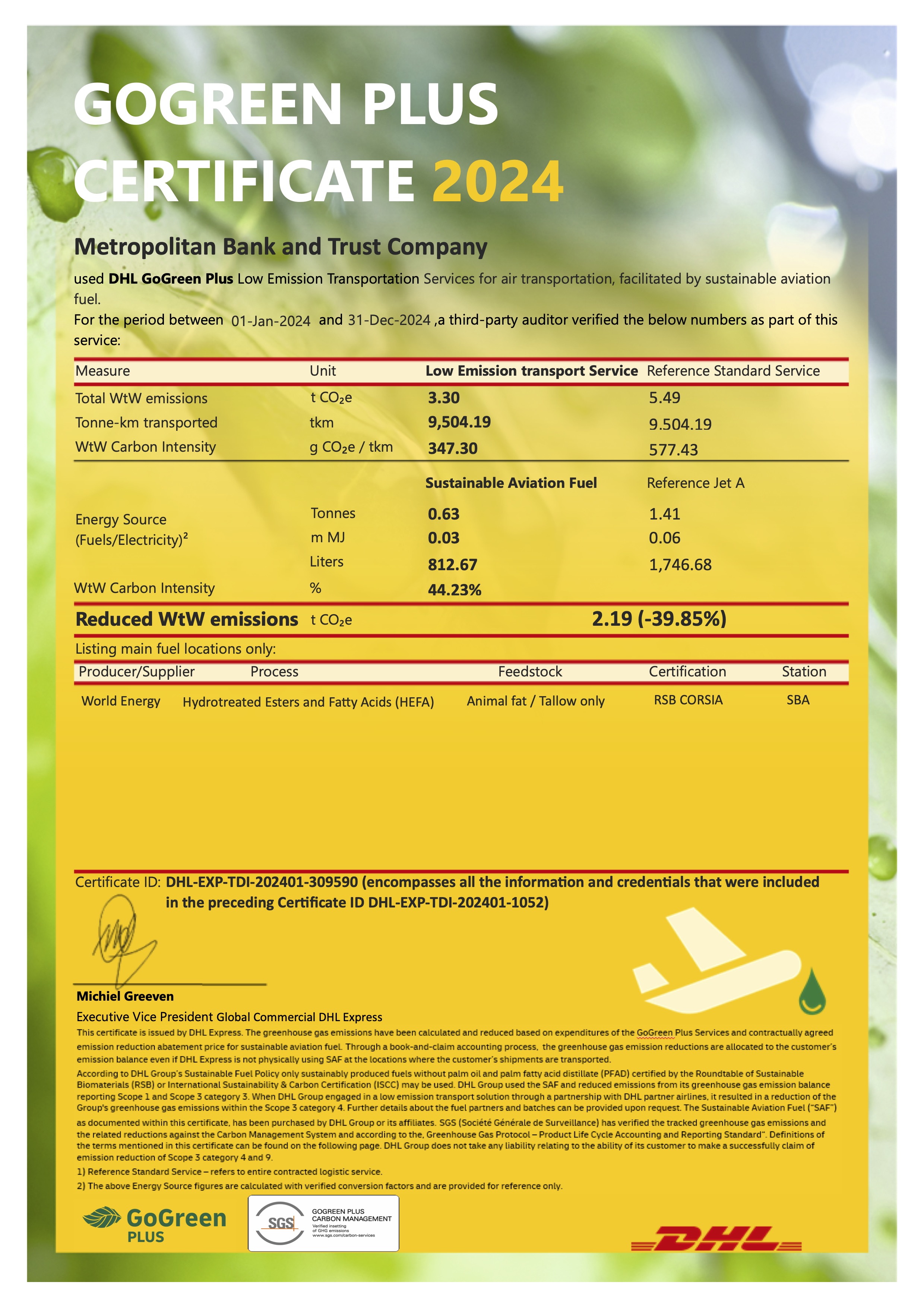
We reduce direct emissions through preventive maintenance for service vehicles and generator sets, and optimize fuel through displacement-based planning. We also reduce value chain emissions through DHL's Go Green Plus Program to achieve reductions in well-to-wheel emissions through partnerships in Sustainable Aviation Fuel
We are preparing to expand reporting beyond Scope 1 and 2, with initial work focused on Scope 3 categories and methodologies for measuring financed emissions under Category 15.
Water and Wastewater Management
We manage water consumption across our branches and centers with care, recognizing it as a shared resource in the urban areas where we operate. We monitor use through utility billing and facility-level tracking, address leaks promptly, and pilot rainwater harvesting at selected locations.
| Water consumption (in cubic meters) | 2023 | 2024 | 2025 |
|---|---|---|---|
| Bankwide | 267,805.3 | 271,241.5 | 272,616.0 |
Bankwide water consumption in 2025 remained broadly consistent with prior year levels, reflecting stable operations and continued application of water management controls. Disaggregation for water-stressed locations remains under assessment as our data systems mature.
0
Water finacing extended, 2025
Supporting water service expansion, source development, non-revenue water reduction, and sewerage and treatment upgrades
Wastewater Management and Discharge
We comply with applicable discharge standards, renew permits for our centers, and operate our Sewage Treatment Plant to ensure wastewater quality meets prescribed limits before discharge.

Waste and Hazardous Materials Management
We manage waste responsibly across all our centers, focusing on prevention, proper segregation, and safe disposal. Our waste comes primarily from office-based activities, and we work with accredited third-party providers where disposal is outsourced. We also track what we generate and stay engaged with government agencies to keep our practices aligned with current requirements.
In 2025, we generated 401.1 tonnes of waste in total: 59% recyclable, 39% biodegradable, and 2% hazardous. Changes year on year reflect shifts in operational activity and continued improvements in how we segregate and recycle.
| Waste generated (in tonnes) | 2023 | 2024 | 2025 |
|---|---|---|---|
| Recyclable | 237.2 | 178.8 | 237.5 |
| Biodegradable | 66.6 | 80.5 | 154.7 |
| Hazardous | 14.7 | 15.3 | 9.0 |
Ecological and biodiversity impact
Through the Purple Hearts Club, our employee chapters turn environmental responsibility into everyday action. In 2025, we carried out 28 environmental initiatives focused on practical, community-based efforts that protect natural resources while strengthening local resilience. Our teams worked alongside host communities across multiple regions, from tree planting and mangrove rehabilitation to coastal and river clean-ups, biodiversity conservation, and pawikan stewardship programs.
Environmental initiatives
28
in 2025
Focus areas
Tree planting, mangrove rehabilitation, coastal and river clean-ups, pawikan conservation
Focus areas
Rizal, Batangas, Bohol, Cebu, Davao, Albay, Laguna, Sorsogon, Benguet, Metro Manila
Environmental compliance
We comply with all applicable environmental laws and regulations, securing required permits across our facilities and coordinating regularly with government agencies to stay ahead of evolving requirements. We also keep actively informed on environmental policy developments to prepare early for regulatory updates that may affect our operations.
PCO training completed in 2025
90
PCOs and managing heads
Our branches are supported through the mandatory 40-hour Basic Training Course for Pollution Control Officers (PCOs), required for DENR accreditation. Our goal is full PCO accreditation coverage across all branches, ensuring every location is equipped to manage environmental responsibilities consistently and effectively.