
Sustainability Report 2025
Our approach to sustainability
We approach sustainability as a core responsibility, weaving economic, environmental, and social considerations into every aspect of how we bank, govern, and grow with our stakeholders.
Sustainability Focus Areas
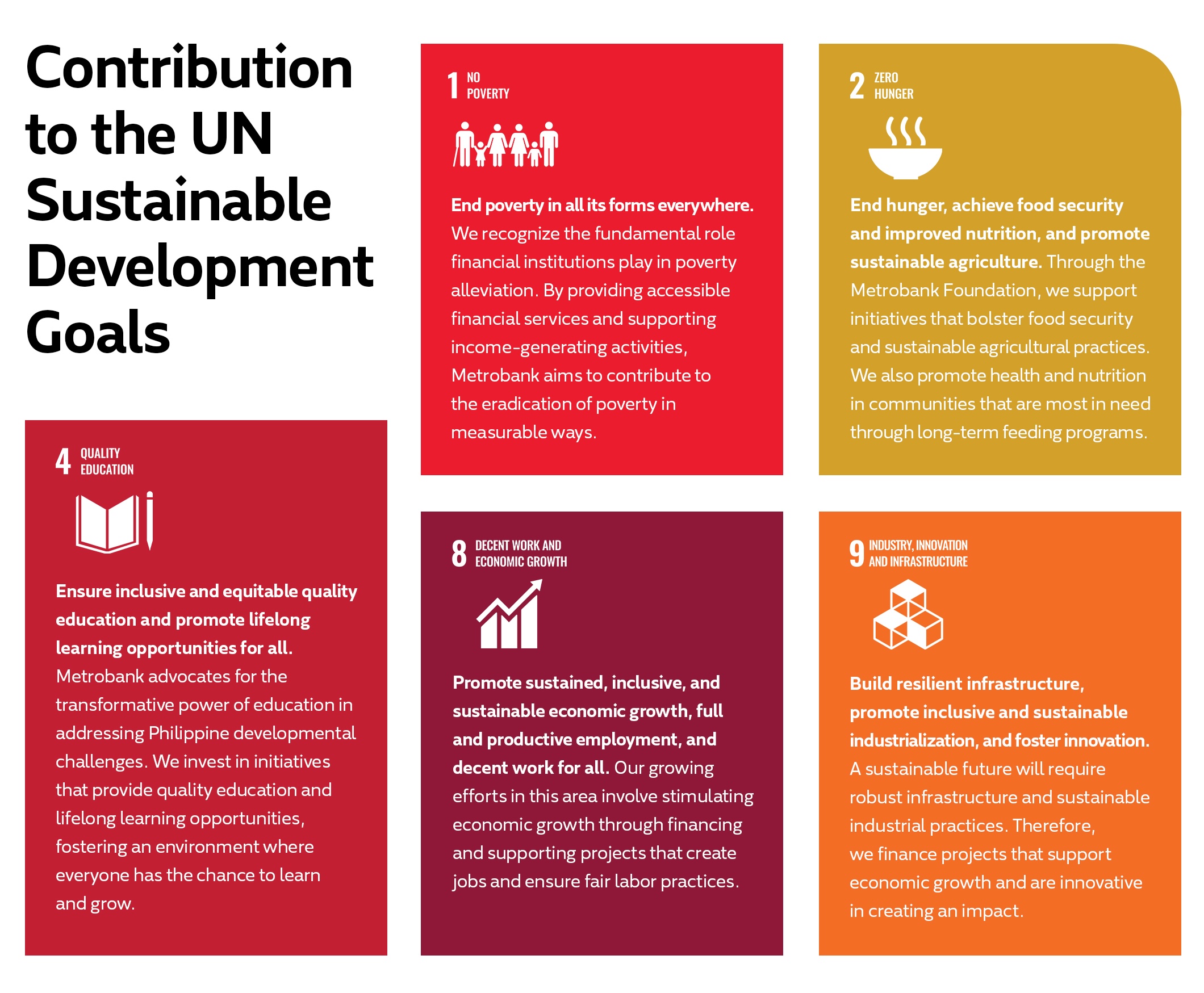
Our work touches all 17 SDGs, but we focus our efforts on five priority goals where our financing creates the most meaningful and measurable impact for the economy and the communities we serve.
Materiality Process
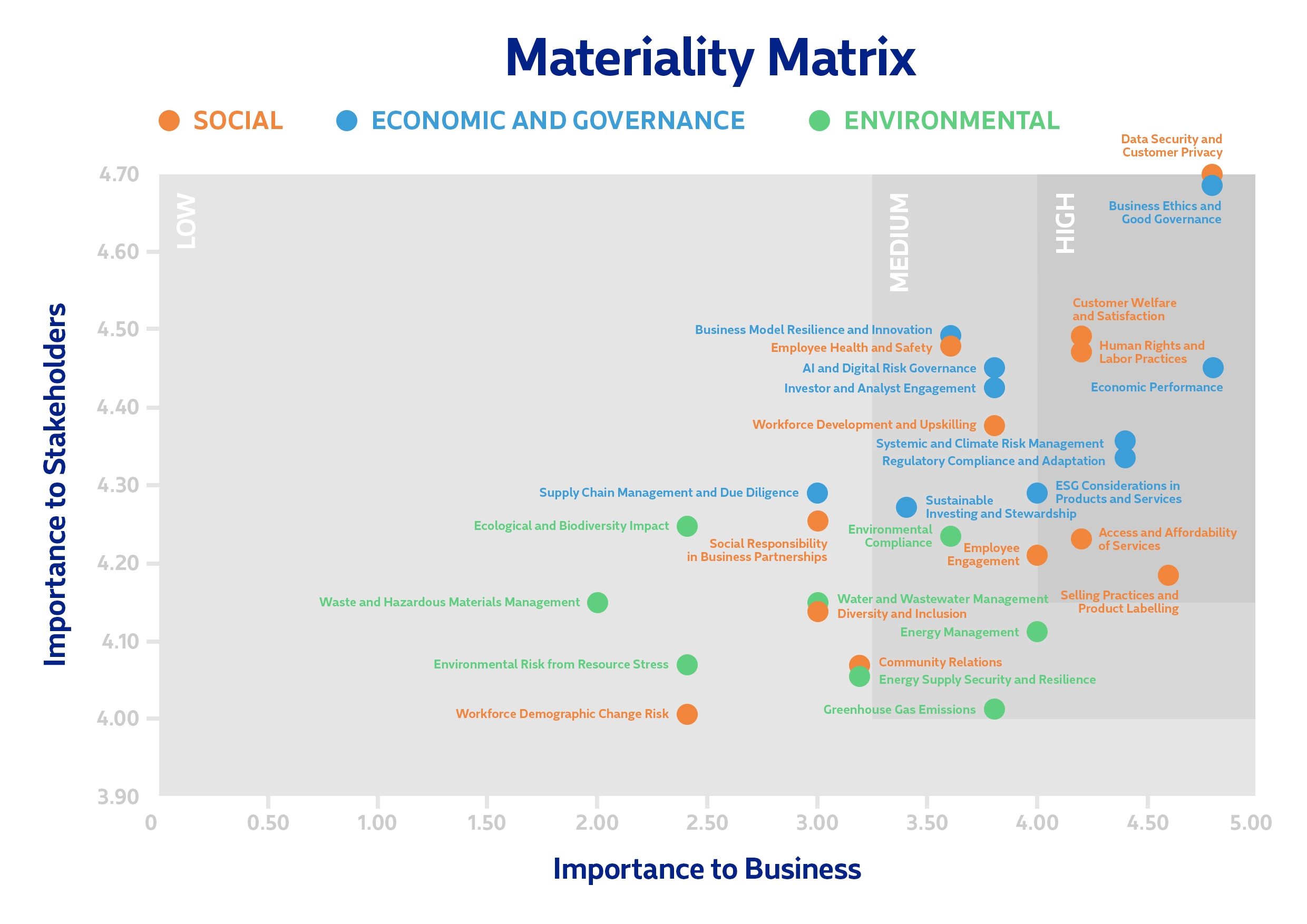
We conduct our Materiality Assessment to ensure our sustainability priorities reflect both the issues that matter most to those we serve and the risks and opportunities that are most consequential to our long-term performance. In 2025, we strengthened this process in alignment with the double materiality principle, examining our outward impacts on the economy, environment, and society alongside the inward financial implications of sustainability risks on our strategy.
We refined the assessment this year by simplifying the stakeholder scoring methodology, refreshing the list of material topics to consolidate overlapping items, and incorporating new and emerging considerations drawn from regulatory developments, corporate strategy, and evolving risks in the sector.
We examined how ESG issues arise across our value chain, from procurement and internal operations to how we engage customers and invest in communities. This helps ensure the topics we prioritize are grounded in the realities of how we operate and the broader ecosystem we are part of.
Impact to stakeholders
We gathered perspectives from a wide range of external groups through surveys and targeted consultations. Equal weighting was applied across groups to ensure balanced and representative input on what matters most.
Impact to business
Our Sustainability Department evaluated each topic against our strategy, operations, financial performance, and regulatory obligations, drawing on the Bank's sustainability roadmap to determine where the greatest risks and opportunities lie.
Topics are plotted on a materiality matrix across two axes: business impact and stakeholder interest. Those scoring high on both are prioritized for strategic action, governance oversight, and disclosure. Medium-priority topics remain actively managed, while lower-priority topics are monitored as conditions develop.
Linking Material Issues to Strategy and Impact
Our assessment surfaces the sustainability issues most consequential to our performance, and to the communities we operate in. These shape our decisions on strategy, risk, and where to invest our efforts.
| Key Issues | Our Response | Link to External Impacts |
|---|---|---|
| Climate-related physical and transition risks ● Risk and cost: Extreme weather can disrupt operations, damage assets, and weaken borrowers’ repayment capacity, particularly in agriculture, real estate, MSMEs, and coastal industries. ● Opportunity and value: Low-carbon transition may affect carbon-intensive sectors while creating opportunities in adaptation and transition finance. | We integrate climate and ESG risks into enterprise risk management, strengthen portfolio monitoring, and expand climate-resilient and transition-aligned financing, including renewable energy and sustainable infrastructure. | Communities and customers are exposed to typhoons, floods, droughts, and heat experience livelihood and infrastructure disruption. These impacts weaken economic resilience and repayment capacity, amplifying systemic financial risk. |
| Cybersecurity, data privacy, and responsible AI use ● Risk and cost: Cyberattacks, fraud, data breaches, bias, and AI misuse can lead to financial loss, regulatory sanctions, and reputational damage. ● Opportunity and value: Digitalization and AI can improve efficiency and service quality. | We strengthen cybersecurity controls, data protection measures, and AI governance frameworks to manage digital risks while enabling responsible innovation and efficiency. | Customers and the financial system face risks to safety, privacy, and trust from cyber incidents and AI misuse, which can undermine confidence in digital banking and financial services. |
| Business model resilience, innovation, and sustainable finance ● Risk and cost: Failure to adapt increases transition and competitiveness risks. ● Opportunity and value: Green and sustainable finance opens new markets and diversifies income. | We expand sustainable finance offerings, including green, transition, and climate-resilient products, to diversify the portfolio and meet evolving client and investor expectations. | Client sectors and communities benefit from financing that supports clean energy, climate resilience, and sustainable livelihoods, helping reduce environmental harm and support economic transition. |
| Access and affordability of financial services ● Risk and cost: Financial exclusion limits growth and raises reputational and regulatory risks. ● Opportunity and value: Inclusive finance supports customer growth and resilience. | We expand inclusive products, digital channels, and partnerships to improve access for underserved segments, while strengthening customer protection. | Underserved and vulnerable groups gain improved access to financial services, supporting economic participation, livelihood stability, and resilience to shocks. |
| Strong governance, ethics, and regulatory compliance ● Risk and cost: Weak governance amplifies financial, legal, and reputational exposure. ● Opportunity and value: Effective oversight supports investor confidence and long-term value creation. | We reinforce governance through Board oversight, clear policies, responsible financing practices, and alignment with evolving regulatory and disclosure requirements. | Stakeholders and markets benefit from transparency, ethical conduct, and credible disclosures, which support trust, regulatory compliance, and market stability. |
Stakeholder Engagement Overview
We engage our stakeholders to stay attuned to what matters, anticipate risks, and make decisions that hold up over time. Insights from these interactions feed into our materiality assessment, risk management, and sustainability disclosures.
Our most recent engagement highlighted heightened expectations around climate resilience, cybersecurity, responsible AI use, financial inclusion, and governance transparency, alongside a call for communication that is both structured and accessible.
| Stakeholder Group | How They are Engaged | Frequency of Engagement | Key Concerns and Expectations | Management Approach |
|---|---|---|---|---|
| Customers | Branch and relationship manager interactions, digital banking platforms, customer service channels, satisfaction surveys, Net Promoter Score (NPS) studies, financial education initiatives, Materiality Assessment Survey | ● Daily ● Annually ● As needed | Service reliability, cybersecurity and data privacy, fraud prevention, accessibility and inclusion, ethical selling practices, ESG-aligned products | Customer assistance and protection programs, strengthened cybersecurity controls, fraud awareness campaigns, continuous digital platform enhancements, inclusive and sustainable financial solutions. |
| Employees | Engagement and pulse surveys, performance reviews, HR Helpdesk (E-Connect), town halls, Workplace platform, training and upskilling programs, employee volunteerism | ● Quarterly ● Annually ● As needed | Compensation and well-being, career development, diversity and inclusion, workplace safety, ESG integration, community involvement | Competitive rewards and benefits, learning and leadership programs, DEI initiatives, health and safety measures, sustainability training and volunteer opportunities. |
| Suppliers | Vendor accreditation and onboarding, procurement processes, performance reviews, contractual engagements, Materiality Assessment Survey | ● Annually ● As needed | Ethical sourcing, transparency, data security, compliance, sustainability expectations | Clear procurement and accreditation policies, supplier due diligence, sustainability-aligned sourcing and monitoring. |
| Investors | Stockholders’ meetings, earnings calls, investor briefings and roadshows, regulatory disclosures, one-on-one engagements, Materiality Assessment Survey | ● Quarterly ● Annually ● As needed | Financial performance, risk management, climate and ESG exposure, business resilience, governance | Transparent and timely disclosures, robust governance practices, integration of ESG considerations into strategy and risk management. |
| Regulators | Compliance reporting, supervisory engagements, consultations, policy discussions, risk assessments, Materiality Assessment Survey | ● Annually ● As needed | Regulatory compliance, financial stability, risk governance, data protection, climate-related risks | Adherence to regulatory requirements, proactive engagement, strengthened risk and compliance frameworks. |
| Community (MBFI Engagement) | Grants and partnerships, focus group discussions, monitoring and evaluation sessions, alumni and beneficiary engagement, social investment and disaster response programs | ● Ongoing ● Quarterly ● Annually ● As needed | Education, health, livelihood, disaster preparedness and recovery, program sustainability | Structured social investment programs, community-driven project design, long-term partnerships and impact monitoring. |
| Assessment Bodies | ESG ratings engagements, sustainability disclosures, due diligence questionnaires, benchmarking exercises | ● Annually | ESG performance, risk exposure, transparency, data quality | Active engagement, continuous improvement of ESG data and disclosures, alignment with global standards. |